
“`html
SCHOLARSHIP APPLICATION GUIDE | CV WRITING
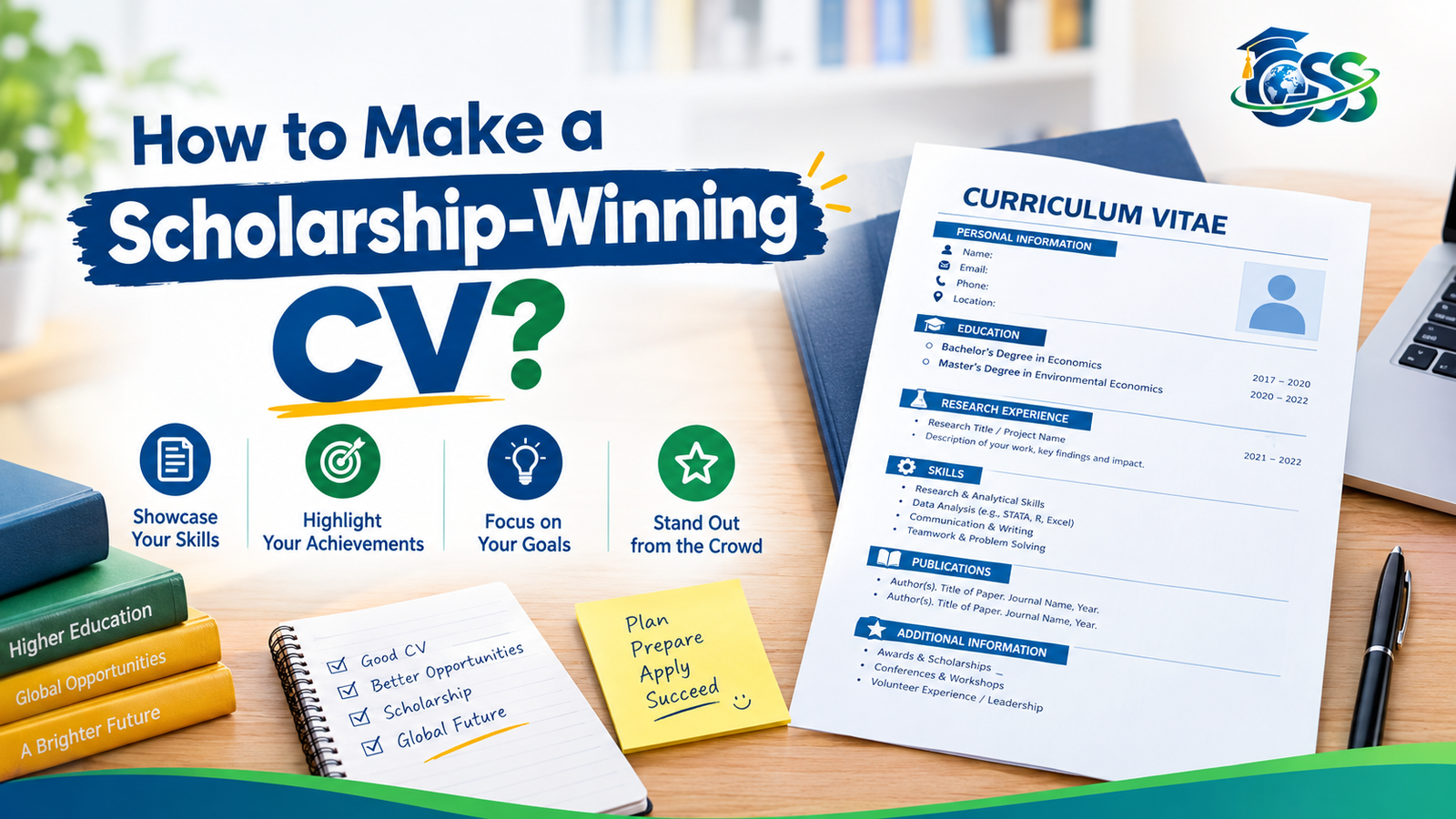
How to Make a Scholarship-Winning CV?
Learn how to create a professional academic CV that highlights your education, research experience, achievements, skills and potential.
A practical guide for bachelor’s, master’s, PhD and other international scholarship applicants.
For scholarship applications, your CV is much more than a list of where you studied and what you accomplished. It represents your academic brand and helps scholarship committees understand whether your background, achievements and goals match their programme.
The good news is that writing a strong CV is a skill you can learn. Once you understand what selection committees look for and how to present your experience effectively, you can create a professional CV that communicates your potential.
Whether you are applying for a bachelor’s scholarship, a master’s degree, a PhD position or a research opportunity, the way you organise your academic information matters. This guide explains what to include, how to structure each section and which common mistakes to avoid for making a scholarship winning CV.
Table of Contents
- Academic CV vs Resume
- The Structure of a Strong Academic CV
- Personal Information
- Education
- Research Experience
- Work and Teaching Experience
- Academic Achievements
- Skills and Expertise
- Certifications and Memberships
- Academic Projects
- Languages
- Volunteer Work and Interests
- References
- Final Tips for a Strong CV
- Create Your CV with Europass
Academic CV vs Resume
Many scholarship applicants lose opportunities because they submit a document that does not suit the purpose of their application. Although people sometimes use the terms interchangeably, a resume and an academic CV serve different purposes.
Resume
- Usually brief and tailored to a specific job.
- Emphasises relevant employment experience and practical skills.
- Often one or two pages, depending on the role and country.
Academic CV
- Provides a more detailed account of academic development.
- Can include education, research, publications, awards and teaching.
- Commonly used for graduate admissions, scholarships and research positions.
To win a scholarship, an academic CV plays a crucial role. CV is particularly important when applying for master’s scholarships, PhD programmes, research positions and academic opportunities. It helps committees assess your preparation for the programme and your potential contributions to the field.
There is no universal page limit for every academic CV. A recent graduate may need only two pages, while a researcher with publications, conference presentations and teaching experience may need more. Follow the institution’s instructions and include only information that adds value.
The Structure of a Strong Academic CV
A well-organised CV makes it easier for scholarship committees to identify your qualifications and strengths. The following sections can help you build a clear and effective document. You do not need to include every section if it is not relevant to your background or application.
1. Personal Information: Keep It Clean and Professional
At the top of your CV, provide the essential information that allows a university or scholarship committee to identify and contact you.
- Full name: Use the name that matches your official documents.
- Phone number: Include the country code if you are applying internationally.
- Email address: Choose a professional address that you check regularly.
- Location: Your city and country are generally sufficient when location information is needed.
- Photograph: Include a professional photograph only if it is customary or requested by the institution or application guidelines.
- Professional profile: Add a relevant LinkedIn profile, academic webpage or portfolio if it strengthens your application.
Your email address matters more than you might think. An address such as fiaz.ali@gmail.com looks more professional than an informal address such as coolguy_786@gmail.com. If your current email is casual, consider creating a new one for academic and professional applications.
Avoid unnecessary personal details such as your father’s name, marital status or complete home address unless the application specifically requires them. Requirements differ by country and institution, so always follow the official instructions.
2. Education: Clear, Complete and Easy to Scan
List your educational qualifications in reverse chronological order, starting with your most recent or current degree. For each qualification, include the following details where applicable:
- Degree or qualification name.
- University or educational institution.
- Graduation year or expected completion date.
- Major, specialisation or relevant field of study.
- Academic distinctions, honours or GPA, when relevant.
Be strategic but honest when presenting your academic record. If your GPA is strong and relevant to the scholarship, consider highlighting it. If it is less competitive, you can give greater emphasis to your research, projects, achievements and relevant experience without misrepresenting your grades.
Scholarship committees may verify your transcripts and qualifications. Never exaggerate your GPA, change grades or claim a degree you have not completed.
3. Research Experience: Show Your Academic Potential
Research experience can help applicants stand out, particularly when applying for master’s programmes with a research component, PhD scholarships or research positions. Include relevant work you have completed or are currently undertaking.
- Published research papers.
- Manuscripts under review or in preparation, clearly labelled with their actual status.
- Current or completed research projects.
- Your bachelor’s or master’s thesis and doctoral dissertation, where applicable.
- Research assistantships or collaborations with academic supervisors.
- Specific research interests relevant to your intended programme.
Be precise about the status of each publication. Distinguish between published articles, accepted papers, manuscripts under review, working papers and ongoing research. Never describe an unpublished paper as published.
Do not worry if you have not published a research paper yet. A well-executed final-year project, a strong thesis, relevant research assistance or a clearly defined research interest can still demonstrate your preparation and motivation.
4. Work and Teaching Experience: Show the Full Picture
Organise your experience into clear categories where doing so improves readability. Relevant categories may include:
- Teaching experience.
- Research experience.
- Professional or industry experience.
- Internships and practical training.
- Academic assistantships or laboratory work.
For academic applications, teaching and research activities can be particularly valuable. If you have worked as a teaching assistant, tutor, laboratory assistant or research assistant, explain your responsibilities and contributions.
Rather than listing only a job title, describe what you did and what you achieved. For example, instead of writing “Responsible for research data,” you could write “Collected, cleaned and analysed survey data to support a research project.”
Whenever possible, use specific examples and measurable outcomes. Do not invent achievements or figures simply to make your CV appear stronger.
5. Academic Achievements: Highlight Your Strongest Accomplishments
A dedicated achievements section can help committees identify your most relevant accomplishments quickly. Depending on your background, include:
- Competitive scholarships and fellowships previously awarded.
- Academic awards, honours and distinctions.
- Gold medals, Dean’s List recognition or verified class rankings.
- Research awards and conference recognitions.
- Other notable academic accomplishments relevant to the scholarship.
Prioritise achievements that demonstrate academic ability, leadership, research potential or commitment to your chosen field. Include the award name and year, and briefly explain its significance if the title alone is not clear.
6. Skills and Expertise: Demonstrate What You Can Do
This section should show the practical abilities you can bring to a degree programme, research project or academic position.
- Programming: Python, R, MATLAB or other languages you genuinely know.
- Research and analytical tools: SPSS, Stata, ArcGIS, QGIS or other relevant software.
- Data skills: Statistical analysis, data visualisation, survey design or qualitative analysis, where applicable.
- Productivity software: Microsoft Word, Excel, PowerPoint and other relevant tools.
- Field-specific skills: Laboratory techniques, modelling, academic writing or specialised methods.
List only skills you can honestly demonstrate. If you include Python, R or a statistical software package, be prepared to explain how you have used it and what you can do with it.
Where helpful, indicate your level of proficiency or provide a brief example of a relevant project. Avoid claiming expertise when you have only basic familiarity with a tool.
7. Certifications and Memberships
Relevant certificates, workshops and memberships can demonstrate that your learning extends beyond formal education.
Consider including:
- Professional training related to your intended field.
- Relevant online courses and recognised certificates.
- Academic workshops, seminars and research training.
- Memberships in professional associations or academic organisations.
- Relevant conference participation or specialised training.
For each important certificate, mention its title, issuing organisation and completion year. Prioritise quality and relevance rather than adding every short course you have ever completed.
8. Academic Projects: Turn Knowledge into Evidence
Projects help committees understand how you apply what you have learned. They are especially useful for students who have limited formal employment or publication experience.
Consider including:
- Your final-year or capstone project.
- Course-based research projects.
- Independent or collaborative research.
- Technical, business or data-analysis projects.
- Practical projects relevant to your intended degree.
For each project, provide a clear title, your role, the methods or tools you used and the outcome. One or two concise bullet points may be enough.
For example, you could explain that you analysed survey data to investigate a research question, developed a software prototype or conducted a cost-benefit analysis for a practical project. Use examples that reflect your actual work.
9. Languages: Make Your Proficiency Clear
Language skills can be important when applying for international scholarships. List the languages you know and describe your proficiency accurately.
If you have taken an English proficiency test, include the test name, score and date when relevant. Examples include IELTS, TOEFL and other examinations accepted by your target institution.
If you do not have a test score, you can still list your languages and indicate whether you can speak, read and write them at a basic, intermediate or advanced level, provided the description is accurate.
Do not claim that you meet a university’s language requirements simply because you have listed English on your CV. Always check the specific programme’s rules.
10. Volunteer Work and Interests
Volunteer experience can be valuable, especially for scholarships that emphasise leadership, community service, social impact or extracurricular involvement.
You might include community projects, student societies, mentoring, educational volunteering or activities in which you had a meaningful responsibility. Explain your role and contribution instead of simply listing an organisation’s name.
You can also include a brief interests section if it adds something relevant to your profile. Keep it concise and prioritise activities that demonstrate useful skills, sustained commitment or genuine involvement.
11. References: Follow the Application Instructions
Not every scholarship application requires references to appear on the CV. Some universities request separate letters of recommendation, while others ask applicants to provide referees’ names and contact details.
Check the official instructions before deciding whether to include this section. If references are required, obtain permission from your referees before sharing their details.
If references are not requested, you can usually leave this section out and use the space for more relevant academic information. Avoid adding “References available upon request” unless you believe it is useful or the institution expects it.
A Few Final Tips Most Applicants Overlook
Your CV Improvement Checklist
- Customise your CV: Adjust the emphasis for each scholarship, university or research position.
- Keep the layout simple: Use readable fonts, consistent headings, clear spacing and a logical order.
- Use strong action verbs: Words such as “analysed,” “developed,” “designed,” “conducted” and “published” can make your contributions clearer.
- Proofread carefully: Check spelling, grammar, dates, contact details and formatting. Ask a trusted mentor or friend to review it.
- Be specific: Describe your contribution and results. Use measurable figures only when they are accurate and verifiable.
- Prioritise relevant information: Put your strongest and most relevant qualifications where the committee can find them easily.
- Save the correct file format: Submit a PDF unless the university or scholarship provider requests another format.
- Follow official requirements: Respect any page limit, naming convention, template or document instructions.
A strong CV does not need to be full of colourful designs, decorative icons or complicated graphics. It needs to be accurate, easy to read and relevant to the opportunity. Your achievements should stand out because of their substance and presentation, not because the document is difficult to navigate.
Create Your CV with Europass
If you need help getting started, Europass provides a tool for creating and organising a CV. You can use it to prepare a professional document, then adapt the content to the specific requirements of your target university or scholarship.
Remember that no single CV template is ideal for every application. Some institutions provide their own format, and academic CVs may require more detailed sections than a standard employment CV. Always follow the scholarship provider’s instructions first.
Ready to Build Your CV?
Watch this video guide to learn how to create a CV using Europass.
Final Words
Your CV is more than a list of facts. It tells the story of your academic journey and helps a scholarship committee understand your preparation, achievements and future potential.
Give yourself enough time to prepare it. Review every section, remove unnecessary information, ask for feedback and update the document as you gain new experience. A thoughtful, well-organised CV can help you present your qualifications more effectively and strengthen your scholarship application.
Remember: your CV is not just your information. It is the presentation of your academic identity. Make it count.
Follow Global Student Scholarships for the Latest Updates
Follow our channels for scholarship announcements, application guides, CV tips and international study opportunities.
 Join WhatsApp
 Subscribe on YouTube
 Follow Facebook
 Follow Instagram
 Follow TikTok
