

SCHOLARSHIP/ADMISSION FRAUD ALERT | ISLAMABAD, PAKISTAN
The Laiba Ijaz Gold Medalist Case: What Happened and How Students Can Protect Themselves from Study-Abroad Fraud
A gold medalist, a fake Harvard admission letter and the lessons every student and family should learn before paying anyone.
Investigation Status: Ongoing
This article was last updated on October 15, 2026. Police and FIA investigations remain open, and some details below remain disputed.
Laiba Ijaz had done everything a student is supposed to do. She finished her Physics degree at International Islamic University Islamabad (IIUI) with a gold medal, and she wanted to go on to Harvard. On October 9, she was found dead in Islamabad. Her family says she had been cheated out of millions of rupees by a man who promised her exactly that.
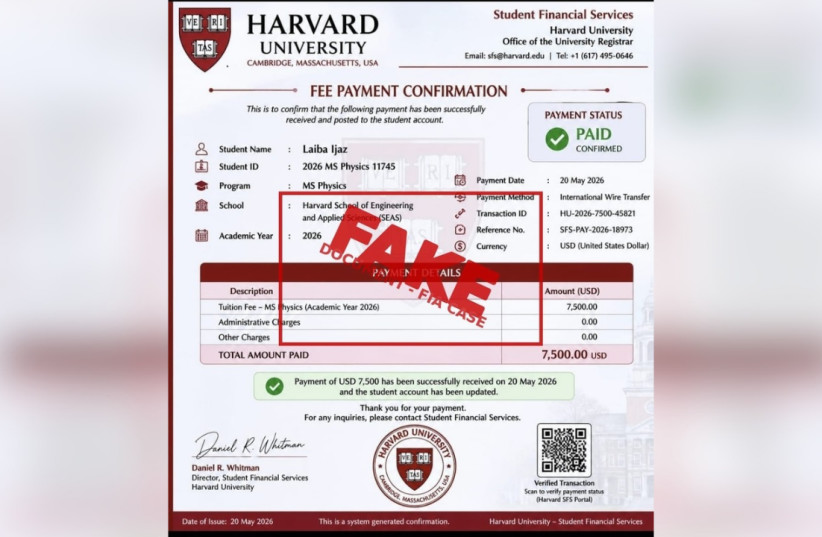
Table of Contents
What the Family Says
Relatives say the man took money in return for a Laiba’s admission to Harvard University and a scholarship. Her maternal uncle, Rana Amjad, told reporters that when the family checked the admission letter, the scholarship letter and the other papers, they were forged. He said the discovery left Laiba in deep distress.
The amount is reported differently depending on the outlet. Some say over Rs7 million; others, Rs9.3 million. One account says Rs2.9 million came through Laiba’s own bank account, and the rest was paid in cash. Her uncle has described how the family sold a plot of land and jewellery to find the money. All of this remains the family’s account and has not been verified in court.
Her age is also inconsistent in the coverage, with reports saying 22 in some places and 24 in others.
Where the Investigation Stands
After Prime Minister Shehbaz Sharif took notice, Interior Minister Mohsin Naqvi and Minister of State Talal Chaudhry visited the family at their home. A fraud case was registered under sections 419, 420 and 109 of the Pakistan Penal Code, along with provisions of the Immigration Ordinance, 1979. Reports also mention a second case dealing with the circumstances of her death.
The names of the suspects have changed as the story developed. Early coverage pointed to one man, but the FIA’s director general later described a different picture. According to him, this was not the usual story of an unlicensed visa consultant. He said the accused posed as an employee of the Supreme Court and was never a consultant at all. Some reports say two people, including a woman, have been detained. Investigators have also pointed to mistakes in the admission letter itself, such as its date, the payment details and the student ID number.
Important Notice
How Laiba Ijaz died is still under investigation, and it would be wrong to assign blame before the facts are established.
The Warning Sign Nobody Caught
One detail has drawn attention from analysts. The family says the offer was for a Master in Physics at Harvard. But Harvard’s Physics Department says it admits students to its PhD programme and does not offer a standalone master’s degree. A single email to the department would likely have exposed the letter as a fake.
What Students Can Do to Protect Themselves
According to Mudassar Chaudhry (Global Study Scholarships), the first thing is that students must apply themselves for either a fully funded, partially funded, or self-funded admission. Second, for fully funded scholarships, there is not a single scholarship offered through any consultants. And yes, if a student wants to apply for partial funding or self-finance, a consultant can help you in admission, but the students who apply through agents (self-funded or partially funded scholarships) should follow the following instructions.
1. Talk to the University Yourself
The university, not an agent, makes admission and scholarship decisions. Before you pay anything, contact the admissions office or the university’s official representative for your country and ask whether your offer is genuine. Find the contact details on the university’s own website. Never use an email address or phone number printed on a document the agent gave you. If an agent claims a link to a university, ask the university to confirm it.
2. Keep Your Original Documents
According to Mr. Chaudhry, no consultant has any right to hold your original passport or certificates. Showing them is fine. Handing them over is not. Universities only need scanned copies, and any original paperwork goes through the embassy at the visa stage.
3. Pay the University Yourself
He recommends sending the application and tuition fees directly through the university’s official payment system, with your name and student ID attached. Refunds generally go back to whoever made the payment, so pay from your own account or from a parent’s or close relative’s. If someone asks for cash or offers to pay on your behalf, walk away.
4. Do Your Own Paperwork
Language test results and bank statements are yours to arrange. A consultant may read your draft statement of purpose and give feedback, but the documents must be genuine and in your own name.
If You Do Hire a Consultant, Check Them Properly.
- Confirm the company is registered with the SECP.
- Ask for any certifications they claim, and verify them with the issuing body rather than trusting a certificate on the wall.
- Ask the university’s representative whether they know the firm.
- Find out how long it has been operating and whether its branches really exist.
- Be careful with online reviews. Consider messaging a few reviewers to ask whether they have actually used the service.
Be Wary of Flattering Offers
Warning signs include a prestigious university contacting you unexpectedly, a scholarship you never applied for, or pressure to pay quickly. The process is straightforward, and nothing will happen to you if you refuse to be rushed.
What Needs to Change at the System Level
Commentators have called for tougher oversight. Ideas include licensing boards with QR codes displayed outside consultancy offices, a simple way for families to verify an offer, open registration of consultants, and faster handling of complaints. One legal writer suggested that universities should connect students in distress with confidential counselling and help them report suspected fraud.
If You Have Been Cheated
Victims often feel too ashamed to speak up. The shame belongs to the fraudster, not to you. Report the matter to the FIA or the police as soon as possible, keep every receipt, message and document, and talk to someone you trust. If you or someone close to you is struggling, please contact a family member, a friend, a counsellor or a mental health helpline.
Final Word
The courts will decide what happened to Laiba. In the meantime, her case shows how a family’s hopes can be turned against them. Before you send money or documents to anyone, check the offer with the university itself.
Follow Global Study Scholarships for the Latest Scholarship Updates
Stay connected for scholarship announcements, application guides and international education updates.
